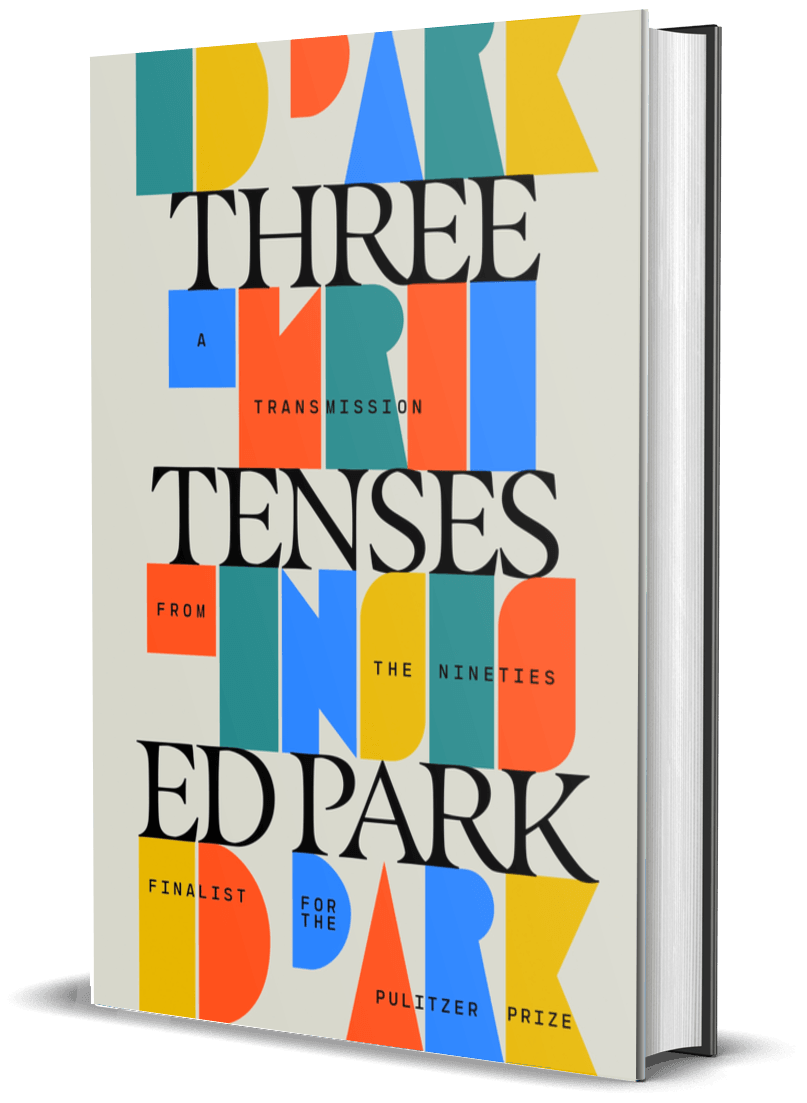
“If Three Tenses was ahead of its time, it is destined to be the last of its kind: a self-portrait of the aspiring person of letters that isn’t insufferable or crazy. The young Park, as he presents himself in Three Tenses, is competitive, witty, proudly erudite, ambitious, self-mocking, eager to succeed, afraid to fail…” —Tablet, “Reading for Pleasure”
“The Pulitzer Prize finalist brings his usual panache, quirk, and insight into his life as a twenty-something…This is brimming with the youthful exuberance of observation. Terrifically fun to read.” —Al Woodworth, Amazon’s Best Biographies and Memoirs of August
“An unusual book stuffed with unexpected and rewarding discoveries—not unlike the discovery of the manuscript itself.” —Elle, “Best New Books to Read in Summer 2026”
“Park is one of the great minds at work in writing today, and Three Tenses is an unmissable opportunity to experience the processes by which he makes sense of himself, past and present.” —The Strand
“Those little, perfect lyrical bursts of prose accrue in the reader’s mind in interesting ways. Though the pieces hopscotch back and forth across the world, our innate mammalian sense of pattern recognition highlights themes and locations and situations that recur in the prose. We begin to piece together a narrative portrait of the novelist as a young man, gathering the pieces of him that he has scattered through time and space.” —Paul Constant, The Seattle Times
“Stray musings and recollections reveal a writer’s restless mind in this scintillating memoir. . . . Ruminations and insights . . . coalesce to illuminate his endlessly curious, mordantly funny worldview. It adds up to an engrossing and beguiling trip through the consciousness of a budding wordsmith.”
—Publishers Weekly, starred review
“Beautiful transmutations of language into imagery…Park does masterfully what any artist is supposed to do in fluctuating measure: Heighten our awareness of the world, enhance it, expand it, explicate it, and, in the bargain, hopefully enlighten and even—heaven forfend— entertain us.” —The Village Voice
“Subversively funny…An exquisitely well-written entertainment.” —Kirkus
“In this work, which defies easy categorization, Park revisits writing he had long believed lost, a collection of essays, experiments, ‘an autobiography with lies.’ Grappling with his own earlier self, the current Park ponders how an artist develops a unique point of view, a voice that can be heard.” —The Boston Globe